

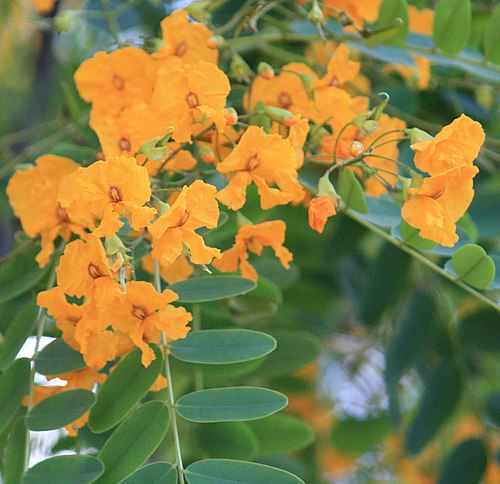
Tipuana tipu, commonly known as rosewood, pride of Bolivia, or tipu tree, is a fast-growing deciduous tree native to the subtropical and temperate regions of South America. It belongs to the Fabaceae (legume) family and is widely planted around the world as an ornamental, shade, and nitrogen-fixing tree. Its attractive yellow flowers and spreading canopy have made it popular in urban landscaping, though in some regions it has become an invasive species.
In Namibia, Tipuana tipu has been introduced and can be found in towns and farms, mostly in the central and northern regions where it provides shade. While it is not a dominant tree, there are growing concerns about its potential spread, especially along rivers where it can naturalise. However, it is also valued in permaculture systems for its ability to improve soil fertility and provide biomass, shade, and timber.
Tipuana Tipu Distribution
- Native range: Bolivia, southern Brazil, northern Argentina, Paraguay, and Uruguay.
- Introduced range: South Africa, Namibia, Zimbabwe, Australia, southern Europe, and parts of Asia.
- In Namibia:
- Most common in Windhoek and other urban areas as a shade and ornamental tree.
- Found on farms as a windbreak or fodder tree, though not yet widely used in large-scale plantings.
- Occasional self-seeding occurs along disturbed sites and riverbeds.
Tipuana tipu is adapted to semi-arid to subtropical climates and can tolerate low rainfall once established, though it grows best in areas with >500 mm annual rainfall. In Namibia, it performs moderately well under irrigation but grows slowly in purely rainfed systems, especially in the Khomas and Otjozondjupa regions.
Status in Namibia
- Introduced species – not indigenous to Namibia.
- Not listed as a declared invasive under Namibian law, but recognised in South Africa and Australia as invasive in some areas.
- Ecological concerns:
- Can spread via seed into natural ecosystems.
- Its dense canopy may outcompete native grasses and shrubs.
- Benefits in Namibia:
- Provides shade in towns, schools, and farms.
- Helps with soil improvement through nitrogen fixation.
- Biomass can be used for mulch, fodder, or compost.
Uses in Permaculture
Tipuana tipu offers multiple functions that make it valuable in permaculture design, particularly in semi-arid landscapes like Namibia:
- Nitrogen fixation: As a legume, it improves soil fertility and supports companion plants.
- Biomass production: Produces abundant leaves and branches suitable for mulch, chop-and-drop, or fuelwood.
- Shade and microclimate creation: Useful as a nurse tree for establishing more sensitive crops and food forest species.
- Windbreak and erosion control: Its spreading canopy and root system reduce wind speed and soil erosion.
- Animal fodder: Leaves and pods can be browsed by livestock in small amounts.
- Timber and craft wood: Provides moderately durable wood, sometimes used in carpentry or fencing.
Cautions in Permaculture
- Invasiveness: Can self-seed aggressively if unmanaged, especially near waterways, but should not spread where browsers punish it during droughts.
- Canopy dominance: Grows into a large shade tree (up to 15–20 m tall), which may outcompete smaller crops if not pruned or managed.
- Branch fragility: Known for brittle branches that may break in storms.
For Namibia, Tipuana tipu is most useful as a temporary nurse tree, supporting early soil building and microclimate creation in agroforestry or food forest systems. Once other long-term productive trees are established, it can be phased out if needed.
Case Studies and Regional Experience
Across southern Africa, Tipuana tipu has been planted in a variety of contexts ranging from urban greening projects to farmland rehabilitation. Its performance shows both the benefits and the caution needed in dryland systems.
- South Africa: The tipu tree has long been used as a street and shade tree in Johannesburg and Pretoria, where its wide canopy moderates urban heat and improves comfort in residential areas. City records highlight that it can tolerate pollution and compacted soils, making it resilient in urban environments. However, the South African Plant Invaders Atlas (SAPIA) notes that it has naturalised in some river systems, particularly in KwaZulu-Natal, where active management is now required (Invasive Species South Africa).
- Zimbabwe: Farmers in Mashonaland have experimented with planting Tipuana tipu as a boundary and fodder tree. It is appreciated for its fast biomass production, which can be pruned and applied as mulch around maize and groundnut crops. Reports suggest that it provides an effective nurse canopy for establishing slower-growing fruit trees such as avocado and macadamia (Practical Action Zimbabwe).
- Namibia: While still relatively uncommon, small permaculture projects in Windhoek and Otjiwarongo have trialled Tipuana tipu in chop-and-drop systems, where regular pruning provides mulch to improve sandy soils. These projects show that, when carefully pruned, the tree can increase soil organic matter and support understory plantings. The Namibia Nature Foundation (NNF) has also referenced the tree in shade-based trials for schoolyard greening (NNF).
- Regional lessons: Case studies from semi-arid zones show that tipu trees excel as pioneer species – creating shade, organic matter, and soil fertility. However, they need ongoing pruning to prevent them from dominating the landscape or spreading uncontrolled. In permaculture design, they are best used as a temporary support species until food forests or multi-layered agroforestry systems are mature.
For more detail on the ecological risks and management practices, see the CABI Invasive Species Compendium (CABI ISC – Tipuana tipu), which provides a global overview of its spread and impacts.